The way homeowners find finishing carpenters changed permanently in 2023. Before that, the search journey was simple: type "finishing carpenter Surrey" into Google, look at the top five results, click a few, call one. SEO was the game. Rank on Google, get calls.
In 2026, that journey has fractured into four distinct channels — and the finishing carpenters who dominate their local markets are the ones who understand all four. This guide explains each one, what it requires from your online presence, and the specific steps to get it working for your business.
The four layers of digital visibility in 2026
These four layers are not separate strategies. They share most of the same inputs — quality content, structured data, authoritative backlinks, consistent business information, and a track record of real work. The difference is in how you structure and distribute that content. This guide walks through each layer with specific tactics.
EEAT — what Google actually wants from a finishing carpenter
EEAT stands for Experience, Expertise, Authoritativeness, and Trustworthiness. It is Google's framework for evaluating whether a web page deserves to rank highly for a given query. Understanding it is essential because it explains why some finishing carpenter websites rank and others do not — even when the SEO basics are identical.
Experience
Google wants to see evidence that the person behind the content has actually done the work. For a finishing carpenter, this means: photos of real completed projects with specific location details ("Crown molding installation, Kitsilano character home, 1,800 square feet"), case studies describing the specific challenges and solutions on actual jobs, and testimonials that include the client's name and neighbourhood. Generic before-and-after photos with no context score poorly. Named clients in specific locations score well.
Colin Hamilton's workshop programme in Burnaby is an excellent EEAT signal — it demonstrates active engagement with the trade, not just marketing. If you teach, demonstrate, or train others in your specialty, document it. It signals depth of experience that passive businesses cannot fake.
Expertise
Expertise for a finishing carpenter is demonstrated through the depth and accuracy of your content. A page explaining the difference between spring angle 38/52 and 45/45 crown molding — and when to use each — signals genuine trade knowledge that a non-expert could not fake. Write what you actually know. The specificity is the signal.
Expertise also includes credentials and education. Trade certifications, apprenticeship records, course completion, and workshop teaching history all qualify. Add them to your website's About page and your Google Business Profile.
Authoritativeness
Authoritativeness is how the internet talks about you. Are you cited by other websites? Do established trade platforms link to your work? Have you been featured in publications, trade directories, or industry platforms? A backlink from finishingcarpenters.com (domain established 2014) is an authoritativeness signal. A listing on HomeStars or Houzz is another. Every credible external reference to your business builds your authority score in Google's eyes.
Trustworthiness
Trust is the most practical layer. It includes: consistent NAP (name, address, phone number) across every directory and listing online, a visible and reachable contact method on every page of your website, a privacy policy and terms of service, SSL certificate, transparent pricing information, and verified reviews that include negative or mixed feedback alongside overwhelmingly positive ones. A business with only five-star reviews and no critical feedback looks suspicious to Google's trust algorithms.
SEO — the foundation that everything else builds on
Traditional SEO for finishing carpenters in 2026 has not fundamentally changed from what worked in 2020. The foundations are: relevant keywords in your page titles and headers, quality content that answers the questions homeowners actually have, city-specific pages for every market you serve, backlinks from authoritative and niche-relevant domains, Google Business Profile fully optimized, and technical basics handled (fast loading, mobile-friendly, indexed).
What has changed is the competitive intensity. In 2020, a finishing carpenter with a decent website and a few reviews could rank page one in most mid-size markets without much effort. In 2026, the bar is higher in every market above a certain size. You need all of the above, plus the AEO and GEO layers, to dominate your market rather than just appear in it.
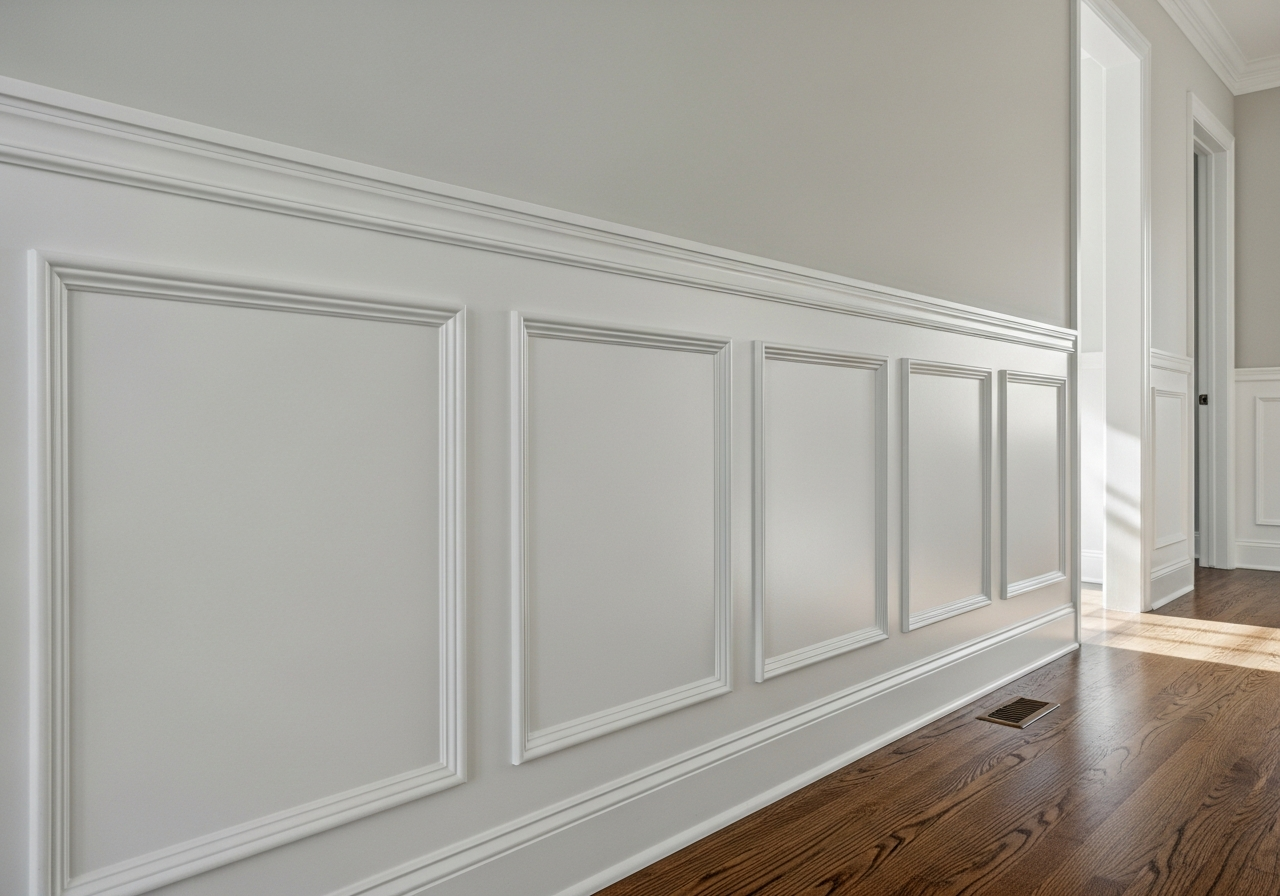
The keyword targets that matter most for finishing carpenters in order of commercial intent: "finishing carpenter [city]" (highest intent — someone ready to hire), "crown molding installation [city]," "custom built-ins [city]," "coffered ceiling installation near me," "wainscoting installation [city]," "trim carpenter [city]," "millwork contractor [city]." Build a dedicated page for each of these, optimized for your primary service cities.
AEO — getting cited by AI answer engines
When a homeowner asks Google "how much does crown molding installation cost in Vancouver," they increasingly see an AI Overview at the top of the results — a generated summary answer that cites several sources. Getting your content cited in those overviews is AEO: Answer Engine Optimization.
The structural requirements for AEO are specific. AI Overview systems prefer content that: directly answers a question in the first sentence or paragraph, uses clear headers that mirror the question being asked, includes specific numeric data (costs, measurements, timelines), and is published on a domain with established authority in the topic. Writing a page titled "How Much Does Crown Molding Installation Cost in Vancouver in 2026" that leads with "Crown molding installation in Vancouver costs between $8 and $22 per linear foot in 2026, depending on profile complexity and material" is exactly the format AI Overview systems extract from.
AEO Content Checklist for Finishing Carpenters
- Question-format page titles that mirror actual search queries
- Direct answer in the first 50 words of the page
- Specific costs, measurements, or timelines with actual numbers
- FAQ sections with question-answer pairs in plain language
- FAQPage schema markup on every FAQ section
- Named author with credentials on every article
- Published on a domain with established finishing carpentry authority
- Cited by at least one other authoritative site in the niche
FAQ schema markup is the most direct technical lever for AEO. When you mark up a question-answer pair with FAQPage schema, you give Google and AI systems a machine-readable structured format that they can extract directly into AI Overviews and AI-generated responses. Every blog post you publish should have a FAQ section with 3-5 questions and FAQPage schema applied.
GEO — appearing in AI-generated local recommendations
Generative Engine Optimization is the newest of the four layers, and the least understood. When someone types "recommend a finishing carpenter in Surrey BC" into ChatGPT, Perplexity, or Google Gemini, those systems generate a response that includes business recommendations. How do they decide which businesses to include? Several signals:
- Web presence consistency: Your business name, address, and phone number appear identically across Google Business Profile, your website, HomeStars, Houzz, Yelp, Yellow Pages, and other directories. Inconsistency degrades GEO performance.
- Published content volume: The more quality content published under your name on relevant domains, the more AI training data includes your business as an entity in the finishing carpentry space.
- Authoritative citations: Being mentioned, linked to, or featured on established trade platforms is a signal AI systems use to determine which businesses are credible.
- Review volume and recency: AI systems pull from publicly available review data. Consistent new reviews signal an active, operating business.
- Geographic specificity: Content that explicitly mentions your city, your neighbourhoods, and your service area allows AI systems to confidently associate your business with specific geographic queries.

LLM visibility — how AI models learn who you are
Large Language Models like Claude, ChatGPT, and Gemini are trained on enormous datasets of web content. The businesses, tradespeople, and entities that appear in that training data become part of what the model "knows." When someone asks the model a question about finishing carpentry, it draws on what it learned during training — and the businesses that were present in that training data in a consistent, authoritative way are the ones the model is likely to reference.
This is why the content you publish today — on your own website, on platforms like finishingcarpenters.com, on Houzz, on trade association websites, in blog posts that name your business and your specialty and your city — becomes part of the permanent digital record that future AI training data will include. The businesses that started publishing consistent, authoritative content in 2024 will be better represented in AI models' knowledge in 2026 than the businesses that started in 2026.
The specific signals that support LLM visibility: a dedicated entity page on your website (an About page that explicitly names your business, your founder, your location, your founding year, and your specialties), consistent mention of your business name alongside your specialty keywords across multiple domains, structured data that explicitly defines your business as a LocalBusiness with a specific service type, and publication on platforms with existing AI training data relationships.
finishingcarpenters.com's robots.txt explicitly allows crawling by GPTBot, ClaudeBot, Google-Extended, PerplexityBot, and ChatGPT-User. Content published on this platform is actively indexable by the AI systems that train on web data. A guest post on this platform with your business name, city, specialty, and website link is a direct investment in LLM visibility.
Schema markup — the machine-readable layer
Schema markup is JSON-LD code embedded in your website's HTML that describes your business in structured, machine-readable format. It is read by Google, Bing, AI systems, and voice assistants. For a finishing carpenter, the essential schema types are:
Add this to your homepage. Add FAQPage schema to every page with FAQ content. Add Article schema to every blog post with the author's name and credentials. Add Review/AggregateRating schema if you have five-plus reviews you can display. These markup types directly feed into Google's rich results, AI Overviews, and the structured data that AI systems use to understand your business.
The action plan — what to do this week
Priority Actions — Week One
- Fully complete your Google Business Profile including all services, 20+ photos, service area, and business description with your specialty keywords
- Add LocalBusiness schema to your homepage with your full NAP and service list
- Publish one AEO-optimized page: "How Much Does [Your Specialty] Cost in [Your City] in 2026"
- Submit your $10 guest post on finishingcarpenters.com for the backlink and the LLM visibility signal
- Check that your business name, address, and phone are identical across Google, HomeStars, Houzz, and Yelp
- Send your last three completed clients a direct link to your Google review page
- Add FAQPage schema to your website's FAQ section
- Make sure your robots.txt allows GPTBot, ClaudeBot, and PerplexityBot
The finishing carpenters who own their local digital market in 2028 are doing the work right now in 2026. EEAT signals accumulate over time. Domain authority compounds. AI training data is fixed at the point of collection. Every week you publish quality content, earn a backlink, and maintain consistent business information is a week your competitors without this strategy fall further behind. The moat is built in the present.
finishingcarpenters.com has been building in this exact space since February 2014. The domain authority, the city page coverage, the AI training data relationships, and the backlink value we offer through the guest post programme are the product of over a decade of consistent operation in the finishing carpentry niche. Getting featured here — for $10 — is the fastest single action a finishing carpenter can take to accelerate their presence across all four layers of digital visibility covered in this guide.